
Sourdough is an excellent ingredient for the unique aromas and flavors it gives bakery products.
However, the main “drawback” when preparing a recipe using Sourdough is that we cannot use it as it is. On the contrary, we must do some elementary steps to “prepare” and reinforce our starter correctly.
In this article, we will see how to do it together!
Which starter fits your recipe and schedule? See the practical comparison of sourdough, yeast, Levain, and Biga.
HOW TO USE SOURDOUGH
Before its use, the Sourdough starter must be fed at least 2/3 times to stabilize its microflora and balance its acidity. The difference between the second and third refreshments is the better shelf-life of the baked product.
Regarding “strength,” nothing changes when we do a third refreshment. In general, for simple doughs (low in fat and sugar) such as bread and pizza, I suggest feeding the starter 2 times. In contrast, you can do 2 refreshments for sweet doughs like Croissants and Brioches and 3 refreshments for more complex leavened products (Panettone, Pandoro). This can be a general rule, but I often make Panettone using a ripe starter on the second refreshment, and I don’t face any problems with that.
When you want to use Sourdough, the first important thing is to ensure the starter is healthy (here, you can learn how to better face the most common issues with Sourdough) and its acidity is well balanced.
In my experience, fixing any issue related to acidity is mandatory before feeding the Sourdough. For this reason, it is crucial to read the principal signals the Sourdough gives us.
HOW TO USE SOURDOUGH STORED IN WATER
If you store your Sourdough in water, the first step is to soak it at 38°C (100°F) in water, adding 2 gr of sugar or fructose/liter, for 15-20 minutes.
After this time, you can feed your Sourdough using the following proportions:
- 1kg of Sourdough Starter
- 1.5kg of Bread Flour (W380 – 14-16% protein)
- 690g of lukewarm water at 30°C (86°F)
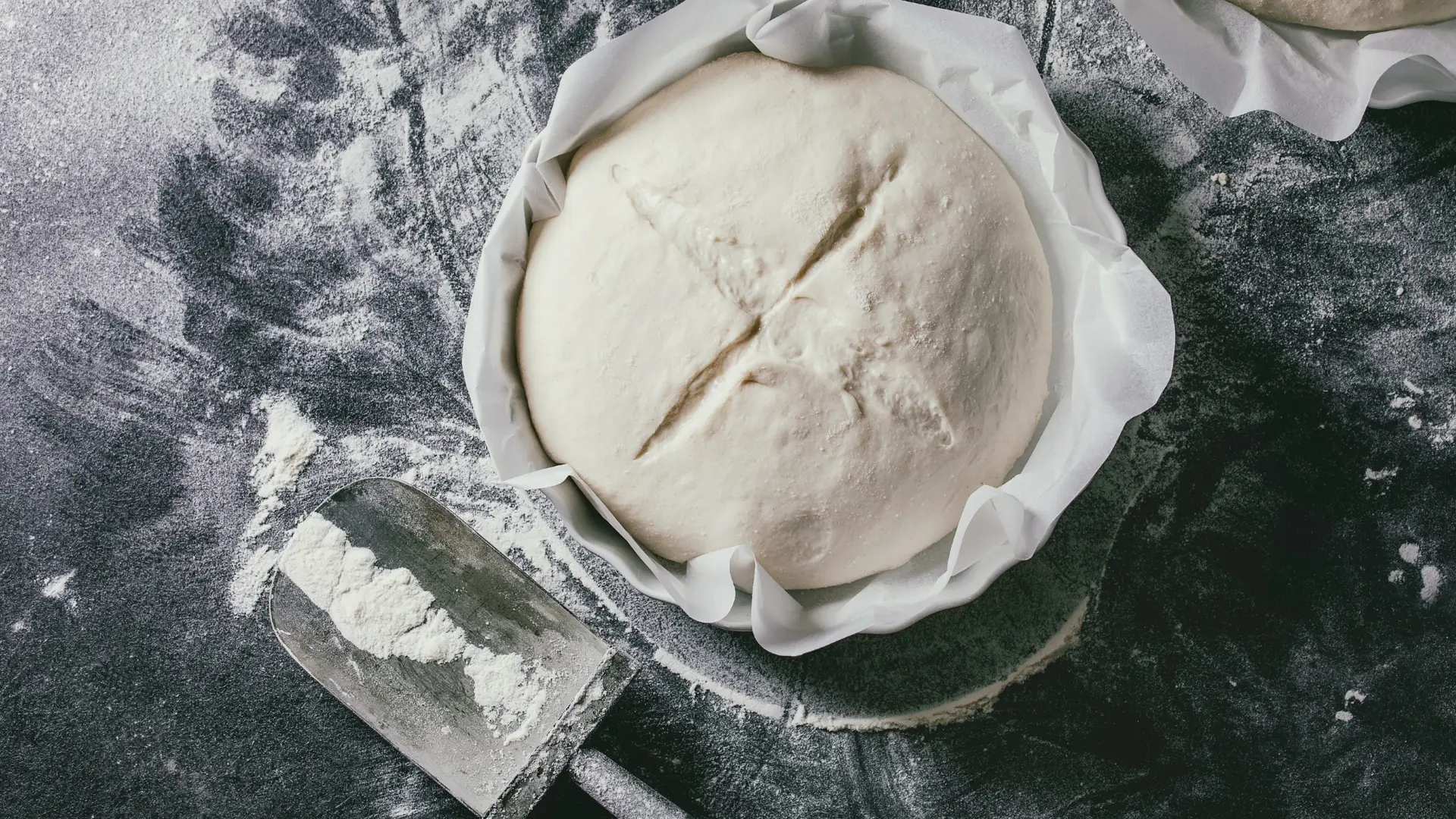
Knead until you have a firm and compact dough, roll out to 1cm thickness, and give 3 folds before forming a ball. Roll the yeast tightly, score the surface to facilitate its development, and place it in a large bowl. Cover with a cloth and ferment for 3½ hours at 30°C (86°F) until it has increased 2½ times its volume (initial volume + 1.5)
To correctly follow the starter’s development, I suggest placing some dough in a glass and marking the starting volume.
For the Second and Third Refreshments, you will knead:
- 1kg of Sourdough Starter
- 1.5kg of Bread Flour (W380 – 14-16% protein)
- 690g of lukewarm water at 30°C (86°F)
and repeat the same process as above.
Now, you can weigh out the quantity of starter needed and use it in your recipe.
HOW TO USE TIED SOURDOUGH STARTER
If you store your Sourdough tied up, your starter will probably be more acidic and, in particular, richer in lactic acidity. In this case, the first step is to take the inner part and soak it in fresh water at 20°C (68°F) – 22°C (71°F) added with 2gr/liter of sugar (or fructose) for about 15/20 minutes.
To better measure the water for the next refreshment, I recommend weighing the starter before and after the bath so you can quickly calculate the quantity of water absorbed.
After the bath, we can feed the starter 2 or 3 times in a row, but changing the amount of flour compared to the previous method (in water)
- 1kg of Yeast
- 2kg of Bread Flour (containing 14% to 16% of proteins)
- 900gr of water – the quantity eventually absorbed during the bath
Once the dough is ready, roll it out to a thickness of 1cm, shape it into a loaf, and score a cross on the surface. Ferment for 3½ hours at 30°C (86°F) until it has increased 2½ times its volume (initial volume + 1.5).
DO NOT FORGET TO STORE YOUR SOURDOUGH
It is essential to always keep a reasonable quantity of starter as a base for future use.
For this, it will be necessary to calculate the correct quantity of starter to refresh to have both the quantity of starter needed for recipes AND a sufficient quantity to store.
I made it simple for you and developed an application to help you!
Once you know how many sourdoughs to feed for your recipe and your stock, you can proceed in this way:
- If you plan to do 2 refreshments, once you complete the second refreshment, weigh the starter needed for the recipe and let it ferment for 3 hours and a half, as described above, at 30°C (86°F). The part you want to store will be soaked in the water or tied up (according to your chosen method) and fed daily or weekly.
- If you plan to do 3 refreshments, Follow the same procedure as above, but take the quantity of dough you want to store straight after the third refreshment.
Discover more about Sourdough Starter
I REPLY YOUR QUESTIONS
If you do not use the sourdough starter often, the most rational solution is to store it in the refrigerator and refresh it every 5 to 7 days. For periods longer than 1 month, you can store the yeast in the freezer. In either case, you must first refresh the Sourdough with specific refreshers.
One way to recover surplus sourdough is to air-dry it first, then in an oven at 100°C for about 40 to 60 minutes, and finally pulverize it in a blender. The resulting powder can be added to bread and pizza dough (about 10gr/kg flour) to enhance the sour note.
Once the 3rd refresh is made, you will need to let the part you need for the recipe rise again for 3 hours at 30°C, while the remaining sourdough starter has to be kept soaked in cold water and left at room temperature for 24 hours. The following day, you can choose whether to refresh it again, keep it at room temperature, or store it in the refrigerator and refresh it every 5/7 days.
How to store the Sourdough Starter
If the sourdough starter is left at room temperature, it should be refreshed every day. If you store it in the refrigerator, it can be refreshed every 5 to 7 days.
To make bread, pizza, and sweet doughs that are not too fatty (such as croissants), you can feed the sourdough 2 times.
If you want to make a very high-fat cake such as Panettone, Pandoro, or Colomba, I recommend you make 3 refreshments before using the yeast in the recipe.
Just proceed with 2/3 close refreshments of 3 hours each at 30°C. With each refreshment, you will get about 2.2 times the initial mass (from 1kg of starting yeast. After only 1 refreshment, you will get about 2.2kg).
How to Feed the Sourdough Starter










14 thoughts on “Come usare il Lievito Madre in cucina”
Quando devo fare il pane faccio prima il rinfresco al lievito e poi posso utilizzarlo.ho posso prendere la parte di lievito e poi faccio il rinfresco
Buongiorno, avevo creato il lievito madre con indicazioni trovare su internet. Lo avevo rinfrescato per una settimana ogni 2 giorni e per una settimana tutti i giorni. Poi L ho utilizzato facendo un rinfresco la sera prima. Il risultato e’ stato deludente: la pasta della focaccia era terribilmente acida. Questo perché prima di utilizzare li lievito bisogna rinfrescarlo 3 volte compreso il bagnetto che avete descritto? Grazie
Ciao Stefania,
prima di usare il Lievito Madre devi rinfrescarlo per 2/3 volte; quindi non puoi farlo la sera prima per impastare la mattina, perché i rinfreschi vanno fatti a distanza di 3ore. In questa pagina ti spiego come Rinfrescare il Lievito Madre prima di usarlo nelle ricette
Ti stai usando il Lievito Madre in pasta, quello classico diciamo, oppure quello che si conserva nel barattolo? Te lo chiedo perché si usano in modo molto diverso!
A presto
Ciao, no è tutto perfetto… Il sapore acido è dovuto alla poca forza del lievito. Noon buttare via nulla, cambia solamente farina cn una più forte, almeno 14 gr di proteine deve avere… Continua rinfresco giornaliero per 3 giorni e vedrai che bomba
Ciao per il lievito madre sto al 6 rinfresco e ce lo sempre in frigo…
Ma già lo posso usare?
Volevo sapere per un kilo di farina quando lievito madre usare?
Come lo devo mantenere in frigo?
Ciao Filippo,
Se stai iniziando da zero il lievito madre non devi tenerlo in frigo… immagino che tu stia usando il lievito liquido nel barattolo!
Se sì, il lievito è pronto da usare quando raddoppiera il suo volume in 3/4 ore a temp ambiente (oppure triplicherà, se usi il lievito madre classico, solido).
Per le altre risposte, ti linko degli articoli in cui potrai trovare
https://biancolievito.it/quanto-lievito-madre-per-un-kg-di-farina/Quanto lievito madre usare per 1kg di farina
https://biancolievito.it/lievito-madre/conservazione/Come conservare il lievito madre
A presto
Il 30 percento di peso della farina va in lievito madre. Se lo rinfreschi giornale. Ente non tenerlo n frigor